
Service
3+2 CNC Machining
Precision machining of multi-sided parts with fewer setups. By indexing and tilting the workpiece, we enable milling and drilling at complex angles.
- Axes
- 5
- Production Volume
- From single parts
- Materials
- Aluminum · Steel · Stainless Steel · Brass
- File Formats
- STEP · IGES · DXF · PDF
Definition
What is 3+2 CNC Machining?
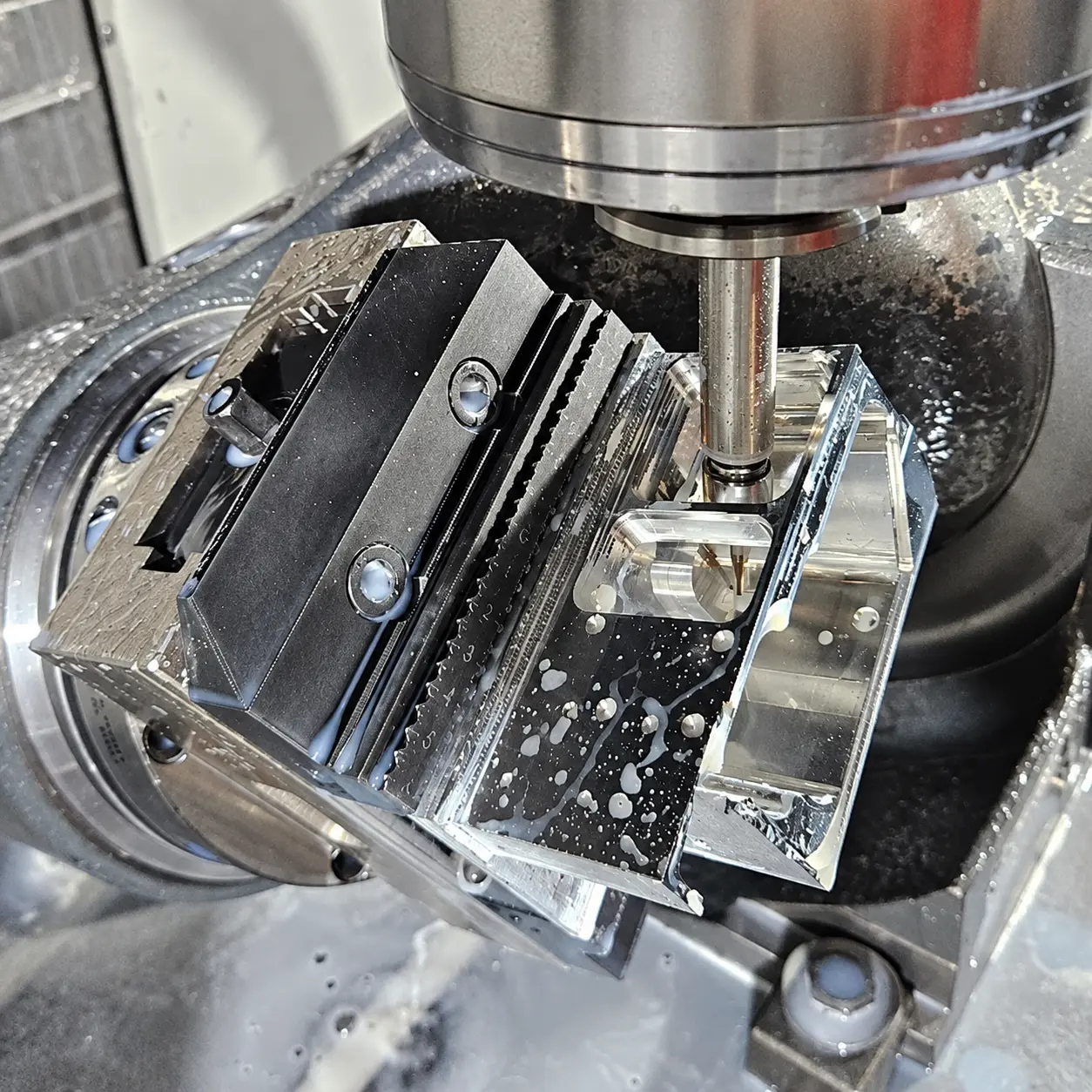
3+2 CNC machining, also known as positional 5-axis machining, utilizes two rotary axes to orient the workpiece into the desired position. During cutting, these rotary axes remain stationary while the tool moves along the three linear axes (X, Y, Z).
This allows multiple accessible sides of the part to be machined in a single setup, including faces, pockets, and holes at complex angles. Fewer setups significantly reduce preparation time and minimize the risk of positional inaccuracies.
At Laika Tech, we machine aluminum, steel, stainless steel, brass, copper, and engineering plastics — from single prototypes to batch production.
- Milling and drilling at complex angles
- Multi-sided machining with fewer setups
Our Service Specifications
| Number of Axes | 5 (X, Y, Z + two rotary axes) |
|---|---|
| Machining Method | Simultaneous 5-axis and 3+2 positional |
| Work Envelope | 915 × 510 × 510 mm |
| Max. Workpiece Weight | 680 kg |
| Tolerance | ± 0.01 mm |
| Materials | Aluminum, steel, stainless steel, brass, copper, plastics |
| Production Volume | From single parts to batch production |
| File Formats | STEP, IGES, DXF, PDF |
| Location | Palinovec, Međimurje, Croatia |
Advantages
Why a single setup
beats multiple ones
Every time a part is re-clamped, it introduces new deviations and consumes time. 5-axis machining handles most surfaces in a single setup — and that precision is visible on the finished part.
-
01
Dimensions between surfaces remain accurate
When the part stays in the vise, there's no stacking of errors from one setup to the next. Holes, pockets, and chamfers maintain the exact relationships specified in the drawing.
-
02
Shorter manufacturing time
The time-consuming processes of preparation, alignment, and measuring for each new setup are eliminated. For multi-sided parts, this is the biggest time-saver in the entire process.
-
03
Superior surface finish quality
By tilting the spindle head, the cutting tool approaches at an optimal angle and operates with a shorter extension. This reduces vibrations, resulting in a cleaner surface and longer tool life.
-
04
Geometries a 3-axis machine can't handle
Draft angles, undercuts, angled holes, and 3D contoured surfaces are manufactured without the need to create custom workholding fixtures.
-
05
Less room for human error
Fewer manual interventions mean fewer opportunities for mistakes — especially crucial during batch production, where a single error would otherwise repeat on every part.
-
06
Lower cost per part in batches
Setup costs are paid once, not for every operation. The larger the production run, the more pronounced the cost savings compared to multiple setups.
3-axis vs. 5-axis machining — what's the difference?
| Criterion | 3-axis Machining | 5-axis Machining |
|---|---|---|
| Setups for a multi-sided part | Multiple setups | Usually one |
| Accuracy between surfaces | Depends on each new alignment | Maintained from a single setup |
| Drafts, undercuts, and 3D faces | Requires custom fixtures or impossible | Achievable without custom fixtures |
| Setup time | Repeated for every setup | Once per part |
| Surface quality | Longer tool extension, more vibrations | Optimal angle and shorter tool extension |
| When is it sufficient? | Flat parts, machining on a single side | Complex parts and tight tolerances |
For simple, flat parts, 3-axis machining remains a sensible solution. However, 5-axis machining pays off immediately when a part has multiple machined sides or demanding dimensions.
Applications
Who orders 5-axis machining
and for what parts
We are most frequently contacted by companies whose parts require multi-sided machining, strict tolerances, or a deadline that leaves no room for error. Here is where our machined parts end up.
Machine Building & Automation
Enclosures, flanges, brackets, and mounts for machinery and assembly lines. Parts that must fit into the assembly perfectly on the first try, without on-site modifications.
Automotive & Motorsport
Prototypes, adapters, mounts, and short-run production parts — crucial when geometries evolve rapidly during development and deadlines are tight.
Food & Beverage Industry
Stainless steel parts for food-contact equipment — featuring smooth surfaces devoid of residue traps, designed to withstand frequent washdowns and cleaning agents.
Laboratory & Medical Equipment
Precision stainless steel and aluminum components for devices and stands, complete with dimensional inspection and thorough cleaning prior to delivery.
Electronics & Thermal Management
Heatsinks, enclosures, and copper components where the flatness of mating surfaces and machining cleanliness are absolutely critical.
Tooling, Molds & Fixtures
Inserts, EDM electrodes, and workholding fixture components — featuring complex geometries that would require supplementary fixtures on a standard 3-axis machine.
Don't see your industry listed? Send us your drawing — we will let you know within 48 hours if the part is manufacturable and provide a quote.
Send a drawingFrom the shop floor
Parts machined on our 5-axis center
A cross-section of what leaves our machine shop in Palinovec — from single custom parts based on technical drawings to production batches for machine building and automation.
FAQ
What clients most often ask about 5-axis machining
On a 3-axis machine, the tool approaches the workpiece only from above, so the part must be unclamped and re-clamped for every new side. On a 5-axis machine, the tool and the workpiece move along five axes simultaneously, allowing most surfaces to be machined in a single setup. This results in more accurate dimensions between surfaces, shorter manufacturing times, and the ability to produce geometries that a 3-axis machine simply cannot.
We machine aluminum, steel, stainless steel, brass, copper, and engineering plastics. If you are working with a material not on this list, please send us the specifications and we will confirm if it is machinable on our equipment.
Yes, it is. We have no minimum order quantity, and for single parts, 5-axis machining is often more cost-effective than 3-axis because it eliminates the need to manufacture custom workholding fixtures and reduces the number of required setups.
We work from STEP, IGES, DXF, and PDF files. If you only have a sketch or an existing physical sample, contact us and we will arrange how to proceed with the technical drawings.
We can. We will measure the sample and create a technical drawing based on it, which we will send to you for approval before machining begins.
We send quotes within 48 hours of receiving your drawing. For highly complex parts, we will immediately inform you of the estimated manufacturing timeframe.
We inspect dimensions using a touch probe while the part is still clamped on the machine, allowing any deviations to be corrected before removal. After machining, the part undergoes a final dimensional inspection according to the drawing.
Yes. Upon request, we offer anodizing, zinc plating, passivation, ultrasonic cleaning, and glass bead blasting, as well as the installation of Helicoil threaded inserts and the press-fitting of dowel pins.
Next Step
Send your drawing — receive a quote within 48 hours.
Send a STEP, DXF, or PDF file with the required quantities and material. We will review the part, confirm if it can be machined in a single setup, and send you a quote with the lead time.
- No minimum quantity — starting from 1 part
- STEP, IGES, DXF, PDF
- Palinovec, Croatia